| Give a two-year-old a crayon and the same shapes appear almost everywhere in the world. The American educator Rhoda Kellogg collected more than half a million children's drawings and listed twenty "basic scribbles": dots, lines, zigzags, loops, spirals. Out of them grow circles, crosses, suns and mandalas, long before a child sets out to draw "a house" or "a person". |
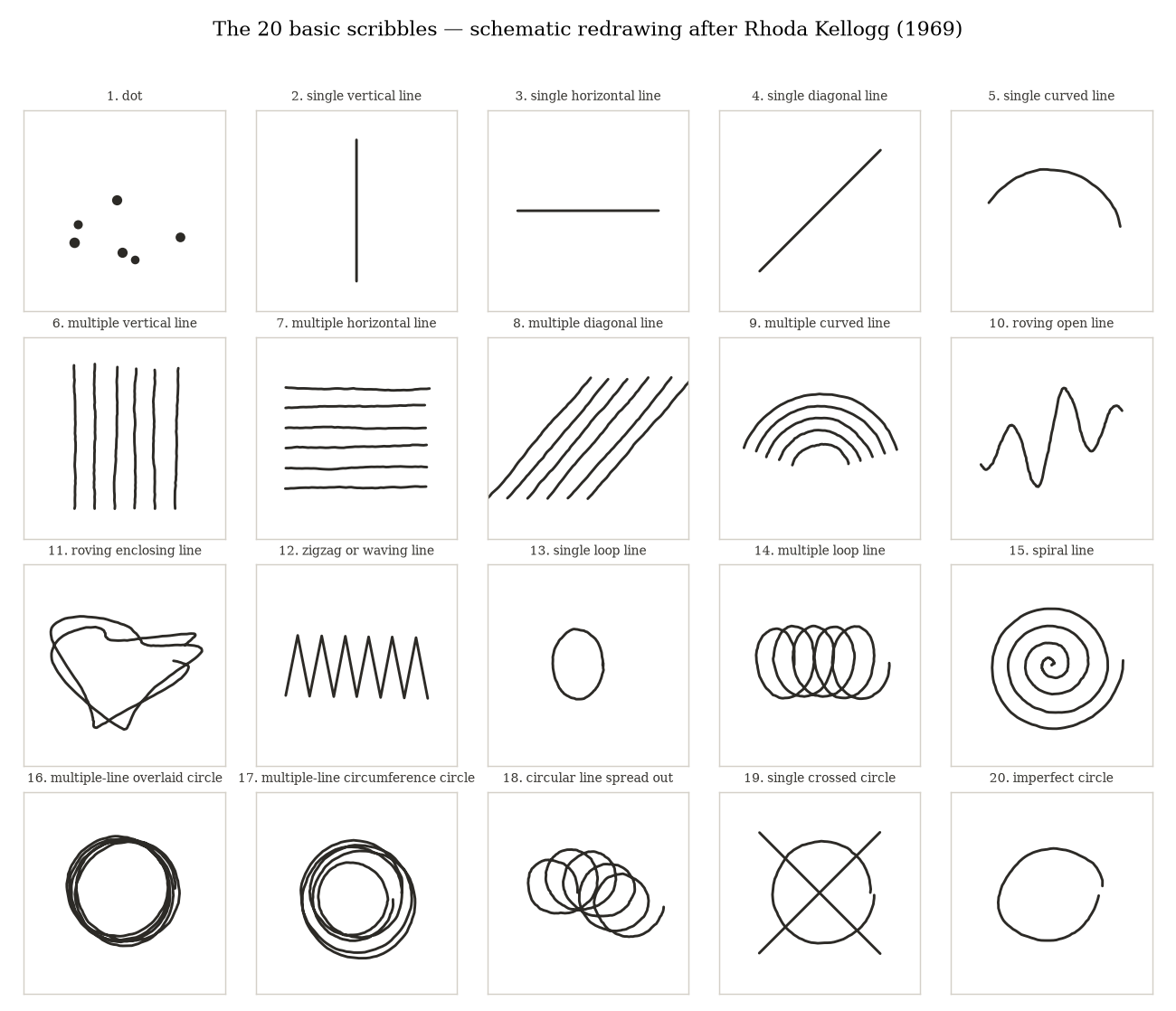 |
| The twenty basic scribbles, from the dot to the imperfect circle. Schematic redrawing after Rhoda Kellogg, Analyzing Children's Art (1969). Diagram: Atelier Joseph Sherriff. |
| One combination deserves a closer look: the circle crossed by two lines. Kellogg called it a "mandala" and counted it among the first combined forms children make, typically around the age of three. Adults have drawn it too. The circle with an equal-armed cross, often called a sun cross or wheel cross, is carved into Bronze Age rocks in Scandinavia, and similar crossed circles appear in many other cultures. What it meant to them is still debated. |
| Arno Stern, whose Closlieu featured in part 2 of this series, saw the same thing and called it the Formulation: a shared vocabulary of forms that rises on its own when nobody is judging the result. |
| The oldest human marks look strikingly similar. At Blombos Cave in South Africa, people engraved cross-hatched lines into blocks of red ochre around 77,000 years ago; on a small stone flake from the same cave, someone drew a similar crosshatch in ochre about 73,000 years ago, the earliest known drawing. In the Ice Age caves of Europe, the researcher Genevieve von Petzinger has catalogued just 32 geometric signs, among them dots, lines, zigzags, circles and grids, repeated across thousands of years. One theory, put forward by David Lewis-Williams and Thomas Dowson, links such signs to "entoptic" patterns the nervous system itself produces in altered states. It remains widely debated, but the family resemblance is hard to miss. |
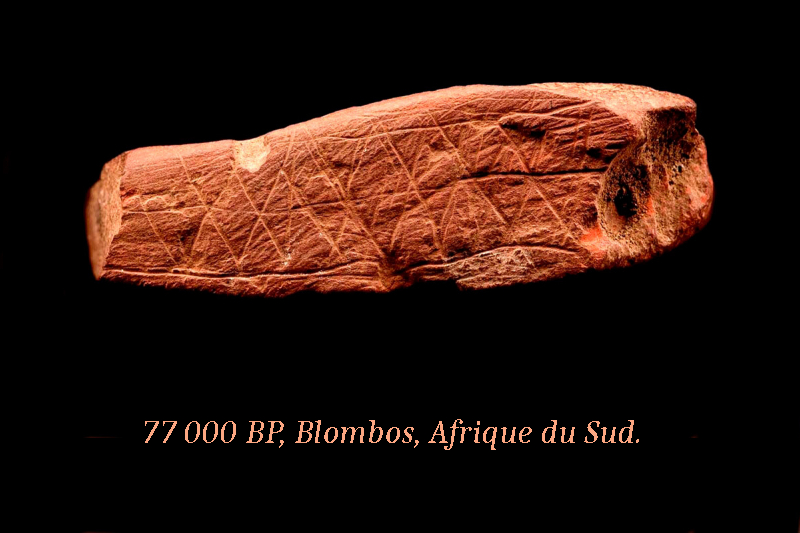 |
| Engraved ochre, Blombos Cave, South Africa, c. 77,000 years ago. |
| And then there is the doodle, the margin of a notebook during a long phone call. In 2009 the psychologist Jackie Andrade asked people to listen to a dull voicemail. Those who shaded shapes while listening remembered 29% more than those who did not. A larger 2024 study did not repeat the effect, so the science is still open. What everyone can observe is what the hand does when attention drifts: spirals, grids, stars, cross-hatching. The same forms again. |
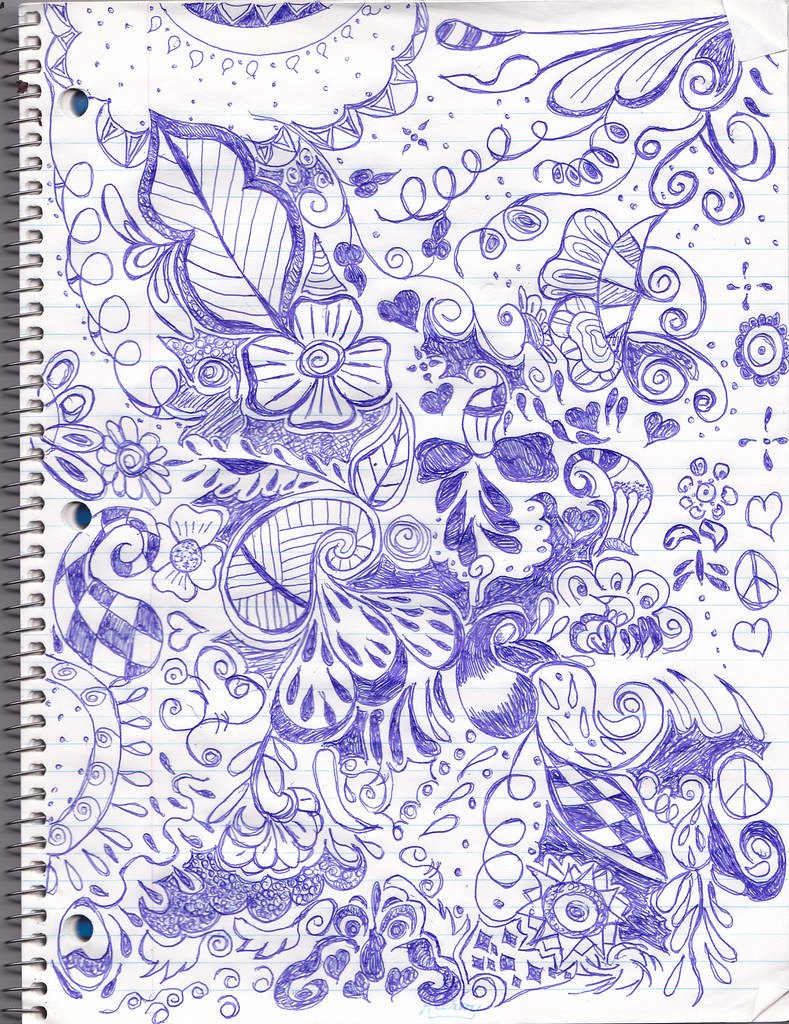 |
| Ballpoint doodle in a notebook: rosettes, sunbursts and loops, the same forms children discover. Photo: Tabcat75, CC BY 2.0. |
| These are the moments when half-conscious form impulses come to light: relaxed, unfocused, not really looking. For a painter, they are worth noticing. Beneath every composition lies this older layer of lines and rhythms that belongs to everyone. |
Part 3 · From the letter of 23 October 2026
Lire en français