| 5) Technical thoughts — The importance of shapes · 2 min read |
| On the two-dimensional surface of a painting support, shapes are approximately what volumes are in three-dimensional space. They occupy the space, and how they fill it up creates imbalances and tensions. |
| As a painter, I express my intention through the center of attention. I want to direct the attention of the spectator along these lines of tension and imbalance to come to a place of resolution. This makes a painting like a story, where the hero is moved by the tensions of his destiny, character, and circumstances towards a confrontation with an antagonist who represents his opposite and complementary qualities (which must be integrated to achieve a new level of harmony and balance). |
| The same principles apply within the composition of a painting, where we see the greatest contrasts at the center of attention. Creating those arrangements of shape that seem to work is an intuitive process best done through iteration and reiteration: trying many times until we find something that works, until we can approach something that works. Reducing the clutter to approach meaning. |
| Many artists have dedicated their whole careers to the study of shapes in greater or lesser degrees of simplicity and complexity. Although shapes seem to be static, they have a subtle inner dynamic, kind of like a tree that grows wider and wider. A shape tends to expand from the centre and to contract at its periphery. There is a movement to the outside, an expansion which gradually slows towards the periphery and becomes hardened at the edge. The other tension or dynamic is the movement that the eye will take around the contour. |
| While the shape may seem static, we actually feel these different kinds of movements. Joan Miró and Frank Webb are two artists who worked specifically on positive shapes, but there are also what we call negative shapes, so-called empty space. I particularly appreciate the work of Eduardo Chillida in this connection. Of course, much of the Japanese and Chinese painting tradition is based around this concept of receptive, open space, which leaves breathing room for mystery. |
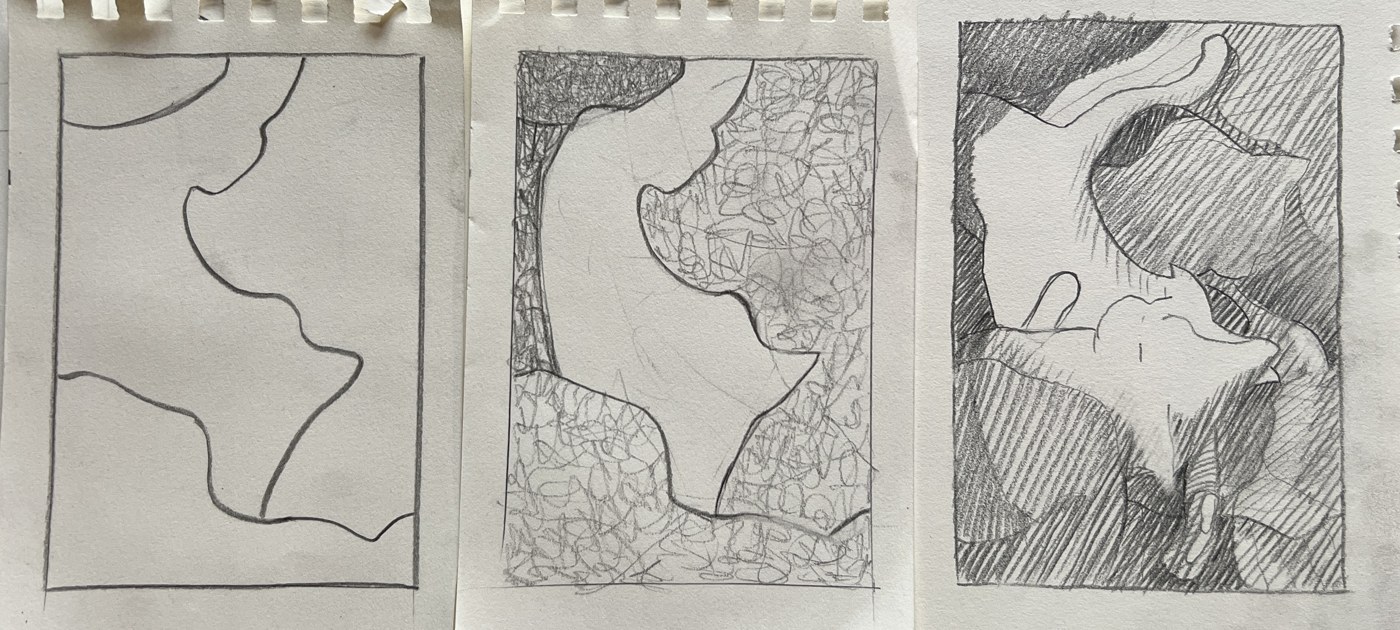 |
| Figure 1: shape study that could become a pile of kittens Three shape-study thumbnails: contour only; the same arrangement with the negative space filled; a tonal version with directional hatching. |
| Atelier Joseph Sherriff |
From the letter of 5 November 2026
Lire en français