| When painting outside in sunlight, we have to consider two sources of light: the warm light coming from the sun, and the cool light coming from the blue sky. That blue light is very pale, and it is easy to overlook if you're not looking for it. |
| The bright sunlight is obviously dominant, and wherever it falls directly, that is the light you will see on the surfaces it strikes. In the shadow areas, where the sunlight doesn't reach directly, the cool blue light of the sky can still be seen. Objects in those shadows are lit by that same cool blue light. Where they are not lit by the sky either, there will be a warm, dark brown shadow. |
| So you have a gradient: warm bright sunlight, cool blue skylight, and then warm dark shadows. Warm, cool, warm again. Those dark shadows are not simply dark brown; it depends on what is in them. They can be dark green, for example, or some nuance of dark brown. They will be dark, but they are not black. They're not blue, and they're not cold. |
| It can be very interesting to spend time just looking into shadows and noticing all the nuances there. That can also afford a richness to our paintings: to vary the shadows in these nuances. Have a look at the Sargent painting above with the rocks, Alpine Pool. See if you can find the blue flecks in the shadows. Now you know why they are there. |
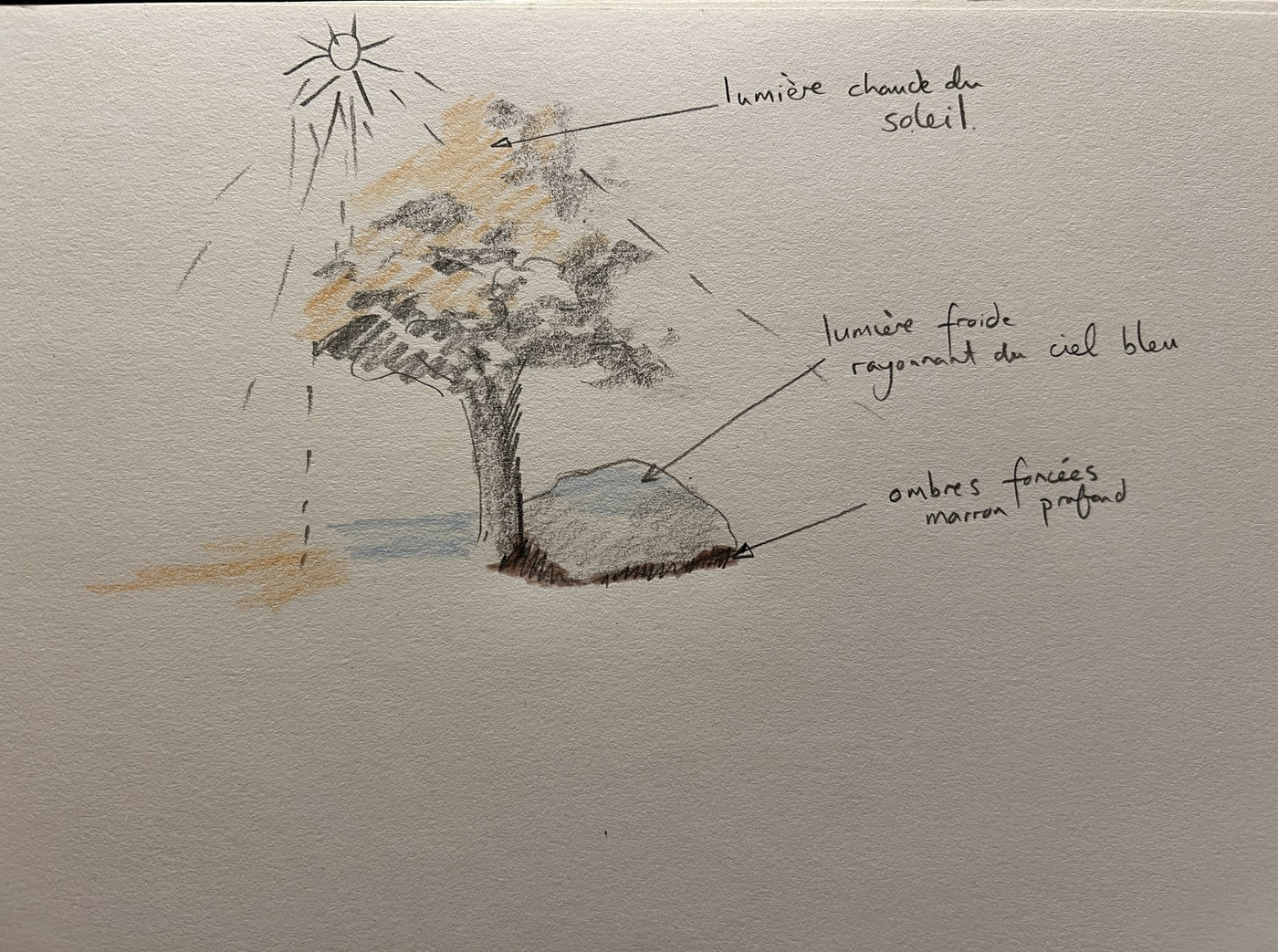 |
| Warm light from the sun, cool light radiating from the blue sky, and darkened, deep brown shadows. Drawing by Joseph E. Sherriff (labels in French). |
| Before I start painting, I mix a group of six colours, from warm sunlight through cool skylight to warm dark shadow: |
| 1. Sunlight: titanium white with a touch of Indian yellow and transparent yellow oxide, which comes very close to the actual colour of sunlight. As this colour deepens and becomes darker, it becomes warmer, so the next two steps follow it down. 2. Deeper sunlight: less white and more of the two yellows. 3. Filtered sunlight: the same, made redder with some transparent red oxide. This is very useful for spots of sunlight that have passed through a forest, for example, before landing on a tree trunk. Filtered sunlight becomes warmer, redder and darker. 4. Pale skylight: white and cobalt blue, for the cool light of the sky-lit shadows. 5. Stronger skylight: the same, with more cobalt blue. 6. Dark shadow: cobalt blue and transparent red oxide, taking care always to stay on the warm side, so it's always a little brown. It never goes quite black, as a mixture of these two complementary colours can. |
| I use these colours almost every time I paint outside in sunlight, so I pre-mix them into tubes. When I get to where I want to paint, I just squeeze these six colours onto my palette. I can mix them with any of the other colours I use that day to create the impression of warm sunlight, cool skylight and dark shadows, and in this way suggest volume and atmospheric variety. |
| Atelier Joseph Sherriff |
From the letter of 13 November 2026
Lire en français