| Joseph E. Sherriff · Studio letter |
| 5 November 2026 · about 13 min read |
| Hello, | | From Saint-Pierre-de-Chartreuse: this week, Edgar Payne and his big outdoor shapes; a new nude study with drape; the anatomy workshop on 15 and 22 November; the Structure tool in Composition; shapes in Technical thoughts; and flow, part 5 of “Why paint?”. | | 1) Featured artists — Edgar Payne: composing outdoors with big shapes · 3 min read | | A few large masses, well placed, before any detail | | Some painting books you read once; others you keep by the easel. Edgar Payne's Composition of Outdoor Painting belongs to the second kind. Published in 1941, it is still in print, and many landscape painters still refer to it. What it offers is not a recipe but a way of looking at an outdoor subject and turning it into a picture. | | Edgar Alwin Payne was born in 1883 near Cassville, Missouri, in the Ozarks. He started out painting houses, signs and theatre sets, then spent only two weeks at the School of the Art Institute of Chicago, which he found too structured; he was largely self-taught, through practice. In 1909 he first saw California and Laguna Beach. He married the painter Elsie Palmer in 1912, and in 1918 they settled in Laguna Beach, where he helped found the Laguna Beach Art Association and became its first president. From 1916 he returned again and again to the Sierra Nevada, his great subject, and he also painted the Southwest, including Canyon de Chelly, on a commission from the Santa Fe Railway. He died in 1947, aged 64. | 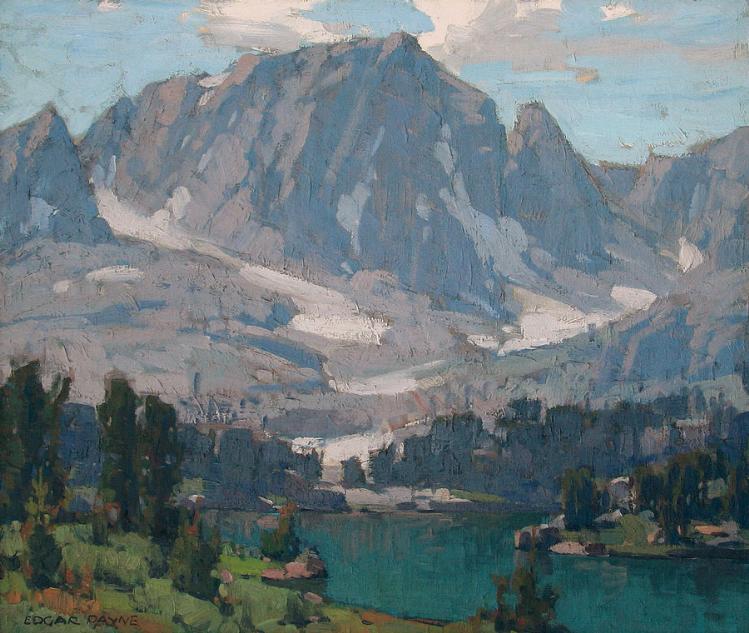 | | Edgar Payne, Big Pine Lake, Sierra Nevada (Temple Crag), before 1947. 63.5 × 76.2 cm. Wikimedia Commons, public domain. | | The heart of the book is a set of composition schemes, which Payne calls "forms". The best known is the steelyard: a large mass near the fulcrum, balanced by a smaller mass placed further out. Alongside it come the balance scale, more symmetrical; the circle or O; the S or compound curve, found in a river or a path; the pyramid or triangle; the cross; radiating lines converging on the centre of interest; the tunnel, where trees or a bridge frame an opening; the L or "ell"; the three spot; and the group mass. Payne is clear that these are not rules. In his preface he warns against the habit of using suggestions as rules or methods to construct pictures. The schemes are for analysis, not for manufacturing paintings. | 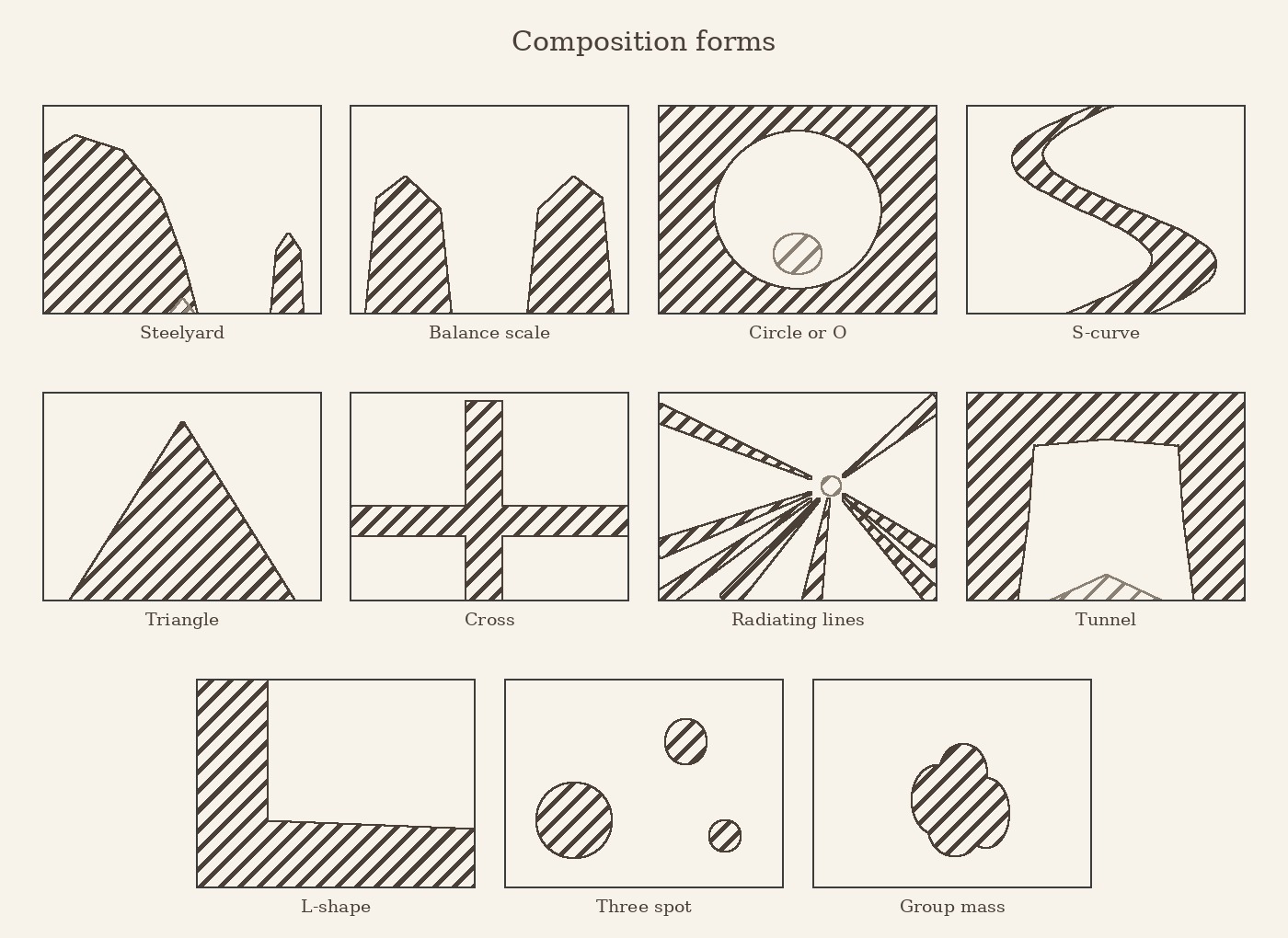 | | The main composition forms Payne describes, drawn as hatched value masses. These diagrams are original; they are not taken from Composition of Outdoor Painting. | | What interests me most in his approach is simplification. In front of a high-mountain view, everything seems to matter: every rock, every reflection, every pine. Payne starts by reducing the subject to a few big value shapes, three or four light and dark masses, and only then places detail inside them. In Big Pine Lake, three masses make the structure: the big light mountain, the dark band of pines, and the even darker lake in the foreground. The snowfields, trees and rocks only animate it. | 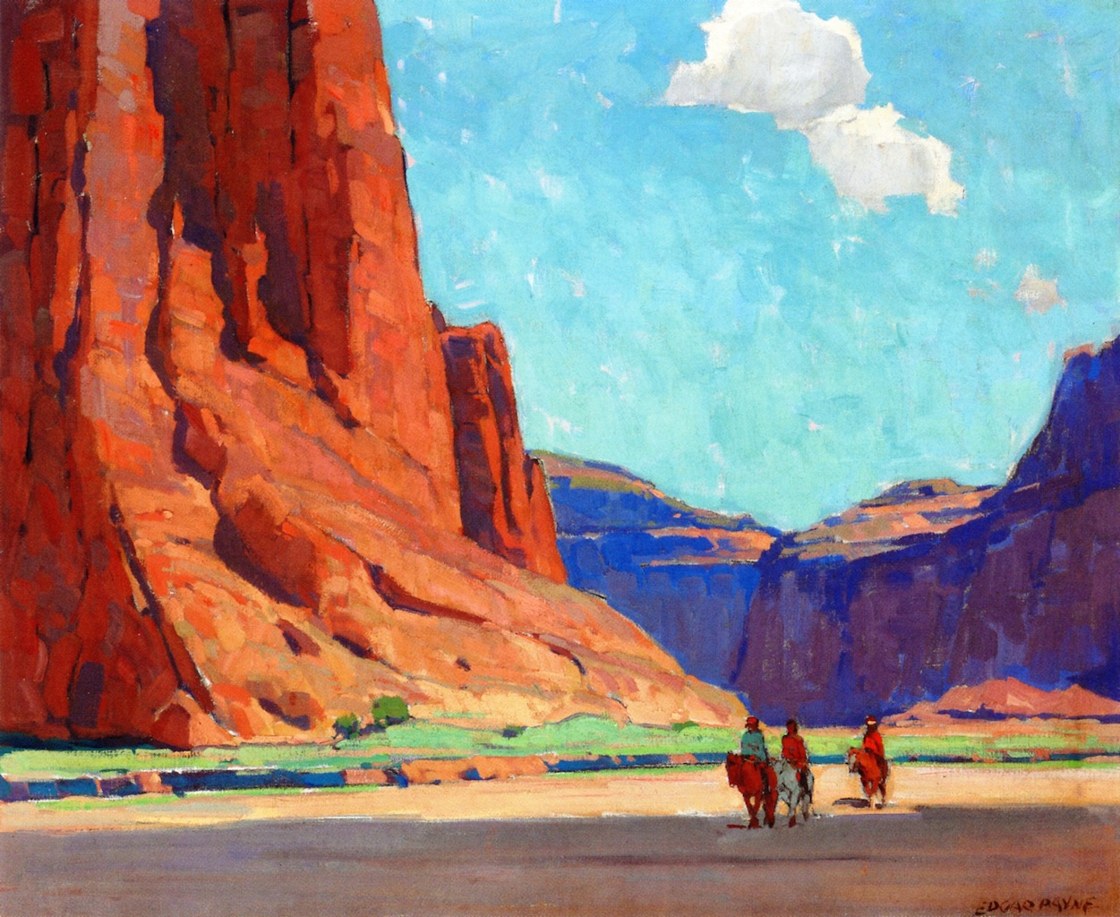 | | Edgar Payne, Riders in Canyon de Chelly, before 1947. Wikimedia Commons, public domain. | | In the Canyon de Chelly riders you can see a steelyard almost literally: the huge sunlit cliff fills one side of the picture, and the tiny group of riders, set far to the right on the light ground, is enough to balance it. The cliff gives the scale; the riders give the meaning. They pick up the warm-and-cool contrast seen in the rest of the picture and, through their small shapes, they add a contrast of size and shape. On top of that, there is the human appeal that draws the eye. | | For us, on the banks of the Guiers Mort, the lesson is direct. Before getting the colours out, ask: what is my big mass, where is my counterweight, and by which path does the eye enter the picture? A small value sketch is often enough to answer, and it saves discovering, three hours later, that the painting has no frame to hang on. | | You can try several of these schemes on your own paintings with the Structure tool in the Composition app, described below. | | Atelier Joseph Sherriff |
| | 2) Seen in the studio: Nude study with drape (5 November 2026) · 2 min read | 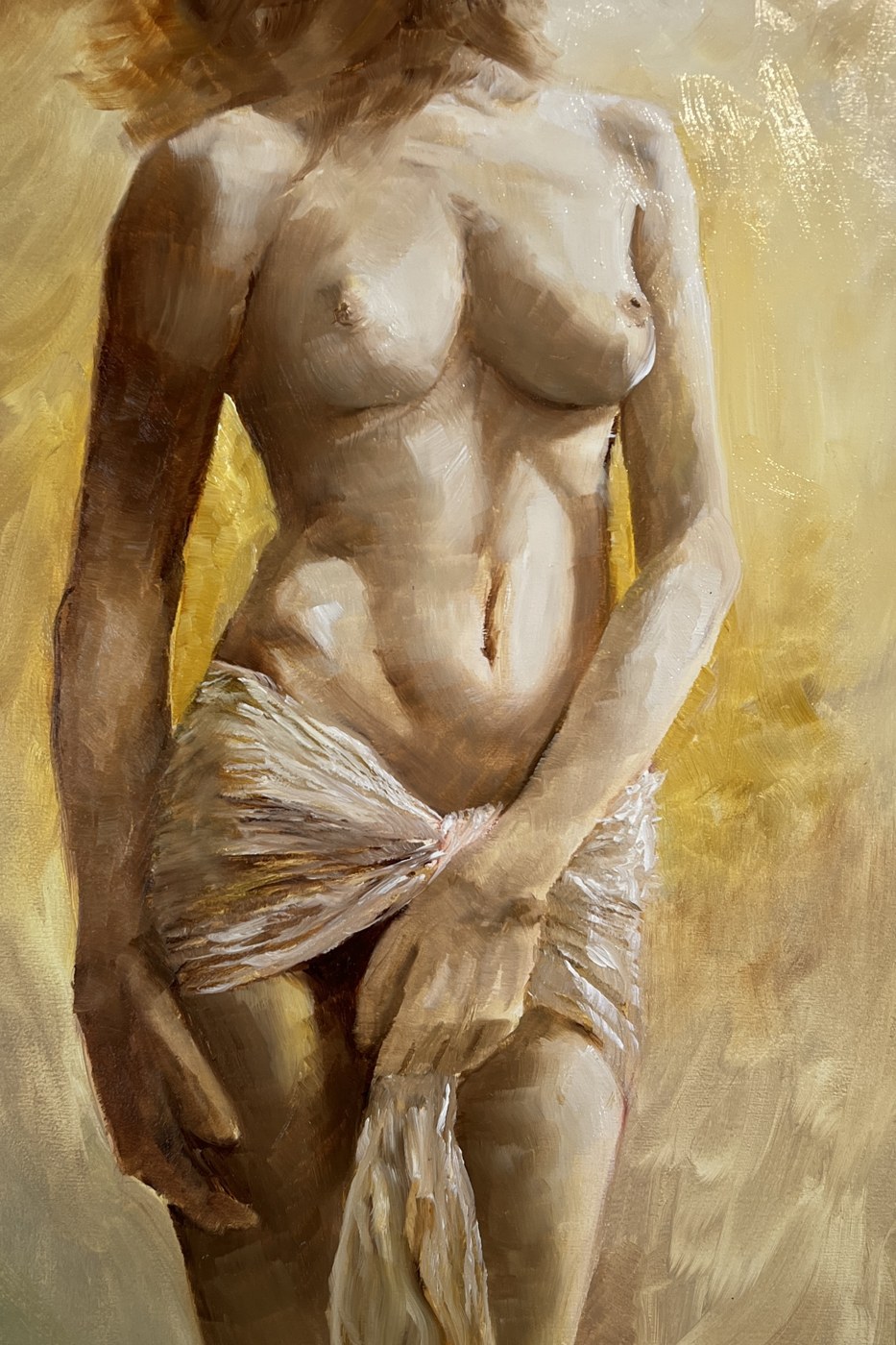 | | Joseph E. Sherriff, Nude study with drape, 5 November 2026. | | For a few weeks, I've been taking a break from landscapes to further explore the human figure, which is a subject I've long found fascinating. At the same time, I'm working on stylistic questions. Ideas are starting to become clear as to where I want to go next. | | I'm very inspired by William Turner and the way he works with light, which has this transcendental quality to it. I'm attracted to the notions of, or the experience of, transcendence, mystery, and even magic, because when we think we can understand the universe and put things into rational boxes, I think we just haven't even started to understand. This feeling of there being more comes through in the light of William Turner. | | I also admire him greatly for his courage as an artist. I admire pioneers, so I'm working towards capturing some essence of that light in my own way. I'm also drawn to high-precision drawing and painting, and I'm trying to connect these two polarities. I think this will be where my work is going in the future, at least in part. | | In this study, I'm working towards this idea of transcendent lighting and, at the same time, precision, which I want to find especially in the feeling of anatomical volume and precision in the underlying structure of the skeleton, fat and muscles. | | I've also reduced my palette considerably, and I'm very pleased with the result because I feel it opens up a lot of possibility and, at the same time, gives a stronger unity to the colors. It's not unlike the Zorn palette, but I am using Indian yellow, transparent oxide red, and cobalt blue. | | I have two whites: | - Williamsburg porcelain white in safflower oil, transparent or semi-transparent;
- Gamblin Radiant White in safflower oil, opaque.
| | I use mainly a Masters Choice angular brush from Rosemary & Co, with a little safflower oil as medium and a little odorless solvent in the beginning. | | Atelier Joseph Sherriff | | 3) Workshop · 1 min read | | Next workshop: “Les fondamentaux de l’anatomie en dessin” (Anatomy fundamentals in drawing). The programme leads to one clear goal: learning to draw a model in contrapposto convincingly. | Sundays 15 and 22 November 2026 · 10:00–17:00 (lunch 13:00–14:00)
Maison Prataz, Les Échelles
€135 for the two days + annual Maison Prataz membership (€15 individual / €20 family). The price is a little higher than usual because it includes the live-model session. Materials included. Adults only, 4 to 6 participants. | | Bookings open, places limited. | | Day 1: the three skeletal masses in an eight-head grid, the bony landmarks, the bony processes and muscle attachments, then the muscle groups (torso, back and neck, limbs). Each participant builds their own écorché, layer by layer, on tracing paper. | | Day 2: the three masses in contrapposto, all the landmarks together, constructing a contrapposto figure from imagination, and in the afternoon a live-model session (« modèle vivant »). | | There are three levels; each participant chooses their own. This workshop can be taken independently of “L’anatomie en mouvement” (Anatomy in motion, 23–24 January 2027). | | Bookings directly with me: joseph.e.sherriff@gmail.com · +33 6 45 76 97 36. (Taught in French.) | | 4) Apps: Composition, the Structure tool · 1 min read | | Several of Payne's schemes, the steelyard, the S-curve, the triangle, the radiating lines, are among the eight structures in the Composition app. | | What holds a painting together? Usually not the details but a few big masses arranged in a simple design: an L, a diagonal, an S-curve, a steelyard balance. The old masters relied on a handful of these structures, and so can we. | | Composition's Structure tool looks at the light and dark masses of your painting and suggests which of eight classic structures it is built on: L-shape, steelyard, S-curve, triangle, diagonal, radial, horizontal bands or frame (coulisses). It names the structure, explains it in one line, and can draw its lines right over your picture. Beside it you'll see a master painting built the same way, such as Corot's Souvenir de Mortefontaine for the steelyard. The screenshots below show the tool on Payne's Riders in Canyon de Chelly, from the opening article. | | It's a suggestion, not a verdict. If you meant something else, tap another structure and compare. That comparison is often where the learning happens: you see whether your design reads the way you intended, or whether a stray mass is pulling it toward something weaker. | | Try it on a recent painting, or better still on a thumbnail sketch before you start. Upload, analyse, then open Advanced features and tap Structure. Sign in for free: you get two free analyses a day, and the Structure tool itself costs nothing. | 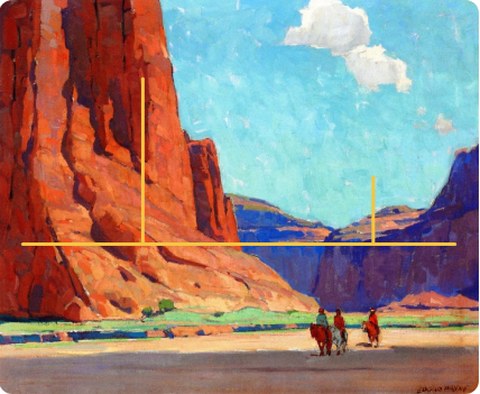 | | Composition, Structure tool: the steelyard on Edgar Payne’s Riders in Canyon de Chelly (public domain). The overlay is the app’s fixed schematic, not a tracing of the painting’s shapes. | 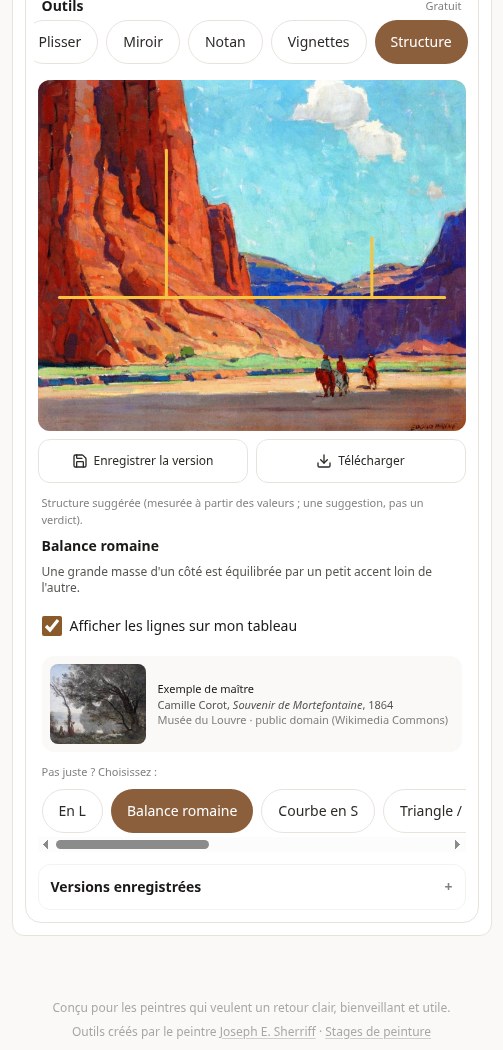 | | The Structure panel in French on a phone; master example: Camille Corot, Souvenir de Mortefontaine (1864, Musée du Louvre, public domain). | | Try it: clearideas.art/composition | | Atelier Joseph Sherriff | | 5) Technical thoughts — The importance of shapes · 2 min read | | On the two-dimensional surface of a painting support, shapes are approximately what volumes are in three-dimensional space. They occupy the space, and how they fill it up creates imbalances and tensions. | | As a painter, I express my intention through the center of attention. I want to direct the attention of the spectator along these lines of tension and imbalance to come to a place of resolution. This makes a painting like a story, where the hero is moved by the tensions of his destiny, character, and circumstances towards a confrontation with an antagonist who represents his opposite and complementary qualities (which must be integrated to achieve a new level of harmony and balance). | | The same principles apply within the composition of a painting, where we see the greatest contrasts at the center of attention. Creating those arrangements of shape that seem to work is an intuitive process best done through iteration and reiteration: trying many times until we find something that works, until we can approach something that works. Reducing the clutter to approach meaning. | | Many artists have dedicated their whole careers to the study of shapes in greater or lesser degrees of simplicity and complexity. Although shapes seem to be static, they have a subtle inner dynamic, kind of like a tree that grows wider and wider. A shape tends to expand from the centre and to contract at its periphery. There is a movement to the outside, an expansion which gradually slows towards the periphery and becomes hardened at the edge. The other tension or dynamic is the movement that the eye will take around the contour. | | While the shape may seem static, we actually feel these different kinds of movements. Joan Miró and Frank Webb are two artists who worked specifically on positive shapes, but there are also what we call negative shapes, so-called empty space. I particularly appreciate the work of Eduardo Chillida in this connection. Of course, much of the Japanese and Chinese painting tradition is based around this concept of receptive, open space, which leaves breathing room for mystery. | 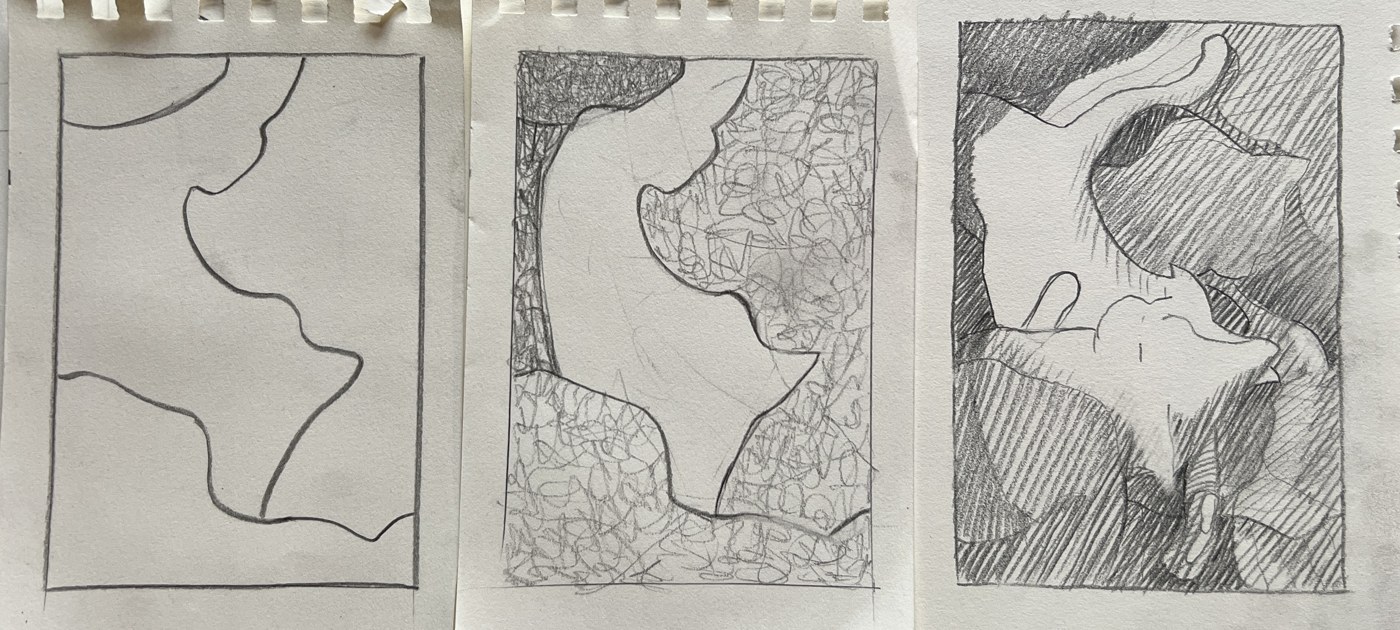 | Figure 1: shape study that could become a pile of kittens
Three shape-study thumbnails: contour only; the same arrangement with the negative space filled; a tonal version with directional hatching. | | Atelier Joseph Sherriff |
| | 6) Why paint? (part 5) — Flow · 3 min read | | Last week, I mentioned how the notion of fluidity became increasingly central to my work, and I realized that there were many technical issues, especially in oil painting, that impeded fluidity. | | For example, the surface you paint on needs to have the right tooth. Your paint needs to have the right consistency. You need to have the right brushes. That means brushes that are flexible and, at the same time, sharp as blades: flexible, but with the right spring. You need to know about your colors. White is a very complex subject, and I will devote an article to that later on. | | Of course, there's the choice of subject, but also how you approach that subject. I had experiences where I was drawing rocks and rivers. The funny thing about rocks is that, unlike facial features, where we have an idea of the proportion, rocks tend to become bigger the more important they are to you, and you suddenly find that the proportions of your drawing are way off. I developed a way of using a visor to ensure my proportions from the beginning, as well as determining the composition, which I've spoken about in a previous article. | | Beyond these technical considerations, there is the experience of working in a state of fluidity. That experience itself is related to what I realized when I started painting again at the end of 2025, after a long break. The guiding principle for me in painting is to feel alive. | | Mihaly Csikszentmihalyi was an American psychologist, born in 1934 in Fiume (then in Italy) to a Hungarian family, who devoted his life to the study of flow. He also coined the term flow because of the thousands of people he interviewed who described this state as being carried by a current. | | As it turns out, we are biologically hardwired through evolution to access certain moments of optimal performance, which we can imagine have been useful in the past for survival. Those parts of the brain dedicated to future planning, the social self, and the experience of time go offline to benefit those parts of the brain exclusively dedicated to the activity at hand. The neuroscientist Arne Dietrich calls this "transient hypofrontality", an idea the writer Steven Kotler has done much to popularise. | | You become one with the activity. You lose your sense of self. You lose your sense of time. You lose any idea of past and future. You are in the now. | | Flow works best when you are challenged, but if you are too challenged, you will be overwhelmed and frustrated, and that is not flow. If you are given a too-boring task, that is not flow either. We all know how grinding boredom can be. What we need to feel most alive, to have an optimal experience, is just the right degree of challenge. We also need a clearly defined goal, and we need direct and unambiguous feedback. The actions follow one another automatically because they are well trained. | | Now that I approach painting with the experience of flow as the central focus, and not so much the final painting, I reserve an hour or two or three, if possible, for this experience with no distractions and a maximum amount of preparation, so that I can step fully into the actual painting part of the activity. | | I have my colors mixed, and my drawing taken care of beforehand, sometimes the night before, so I can get started first thing in the morning, while the house is still asleep. | | I choose the moment of painting as the true flow moment, and when I'm in it, I forget everything else, like a musician playing on stage, where there is no going back and forth. The experience is a reward in itself. | | Atelier Joseph Sherriff |
| | 7) Shop · 1 min read | 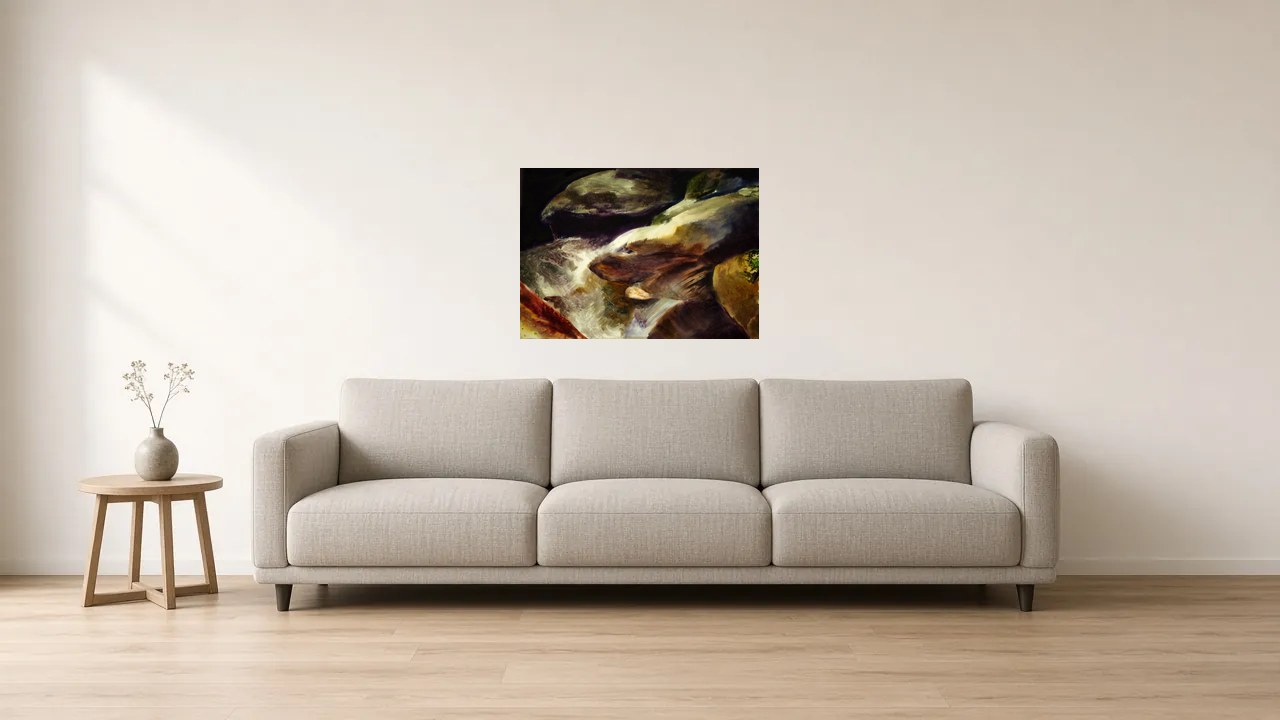 | | Bear’s head rock, watercolour on wet paper, 51 × 71 cm, seen “in your room” (the “See it in your room” sample living room, to scale). | | The shop on joseph-sherriff.com is temporarily offline until Saturday morning, 7 November (Paris time), for technical reasons. The links below will not work until service resumes. | | A painting is only really judged on the wall. On every shop page, the “See it in your room” button shows the work to scale in a living room, a dining room or a chalet entrance, and you can even try a photo of your own wall. Shown here: Bear’s head rock, watercolour on wet paper, 51 × 71 cm, €750.00. | | See the work: joseph-sherriff.com/en/products/bears-head-rock. Originals painted in the Chartreuse are available in the shop: joseph-sherriff.com/en. |
| Thanks for reading. |
Joseph E. Sherriff
Atelier Joseph Sherriff · Saint-Pierre-de-Chartreuse
joseph-sherriff.com
Instagram: @j.e.sherriff
joseph.e.sherriff@gmail.com · +33 6 45 76 97 36
Website temporarily offline until Saturday morning, 7 November (Paris time). |
|
|