| 1) Featured artists — Edgar Payne: composing outdoors with big shapes · 3 min read |
| A few large masses, well placed, before any detail |
| Some painting books you read once; others you keep by the easel. Edgar Payne's Composition of Outdoor Painting belongs to the second kind. Published in 1941, it is still in print, and many landscape painters still refer to it. What it offers is not a recipe but a way of looking at an outdoor subject and turning it into a picture. |
| Edgar Alwin Payne was born in 1883 near Cassville, Missouri, in the Ozarks. He started out painting houses, signs and theatre sets, then spent only two weeks at the School of the Art Institute of Chicago, which he found too structured; he was largely self-taught, through practice. In 1909 he first saw California and Laguna Beach. He married the painter Elsie Palmer in 1912, and in 1918 they settled in Laguna Beach, where he helped found the Laguna Beach Art Association and became its first president. From 1916 he returned again and again to the Sierra Nevada, his great subject, and he also painted the Southwest, including Canyon de Chelly, on a commission from the Santa Fe Railway. He died in 1947, aged 64. |
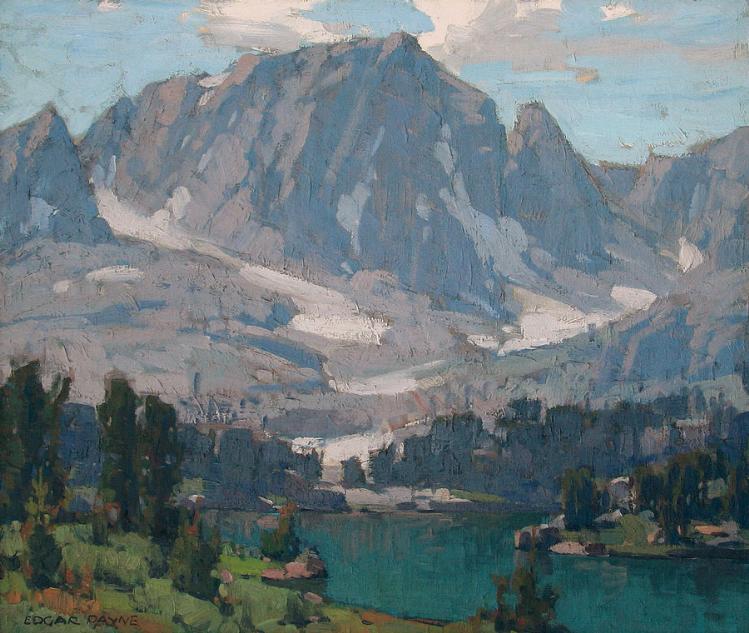 |
| Edgar Payne, Big Pine Lake, Sierra Nevada (Temple Crag), before 1947. 63.5 × 76.2 cm. Wikimedia Commons, public domain. |
| The heart of the book is a set of composition schemes, which Payne calls "forms". The best known is the steelyard: a large mass near the fulcrum, balanced by a smaller mass placed further out. Alongside it come the balance scale, more symmetrical; the circle or O; the S or compound curve, found in a river or a path; the pyramid or triangle; the cross; radiating lines converging on the centre of interest; the tunnel, where trees or a bridge frame an opening; the L or "ell"; the three spot; and the group mass. Payne is clear that these are not rules. In his preface he warns against the habit of using suggestions as rules or methods to construct pictures. The schemes are for analysis, not for manufacturing paintings. |
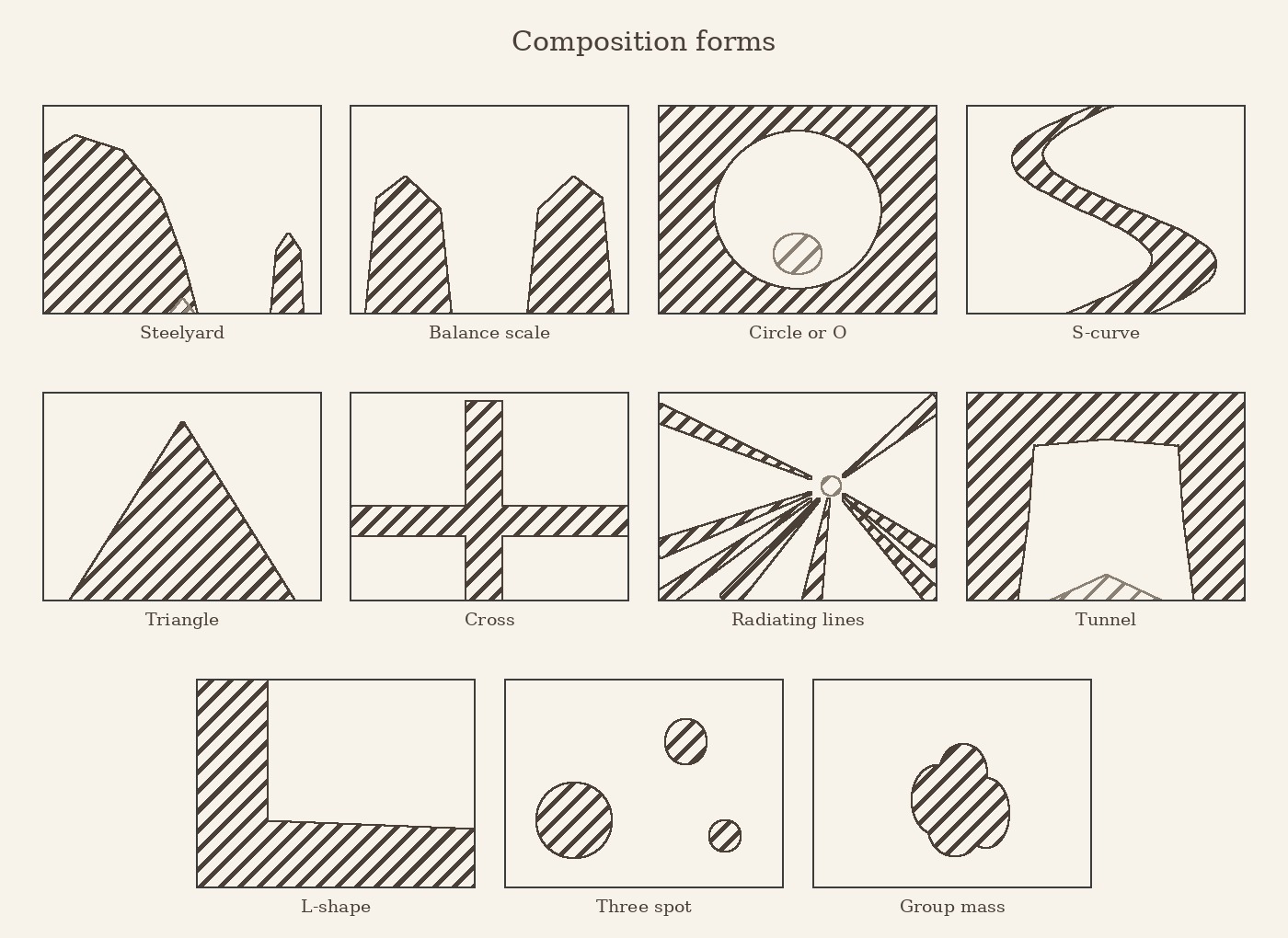 |
| The main composition forms Payne describes, drawn as hatched value masses. These diagrams are original; they are not taken from Composition of Outdoor Painting. |
| What interests me most in his approach is simplification. In front of a high-mountain view, everything seems to matter: every rock, every reflection, every pine. Payne starts by reducing the subject to a few big value shapes, three or four light and dark masses, and only then places detail inside them. In Big Pine Lake, three masses make the structure: the big light mountain, the dark band of pines, and the even darker lake in the foreground. The snowfields, trees and rocks only animate it. |
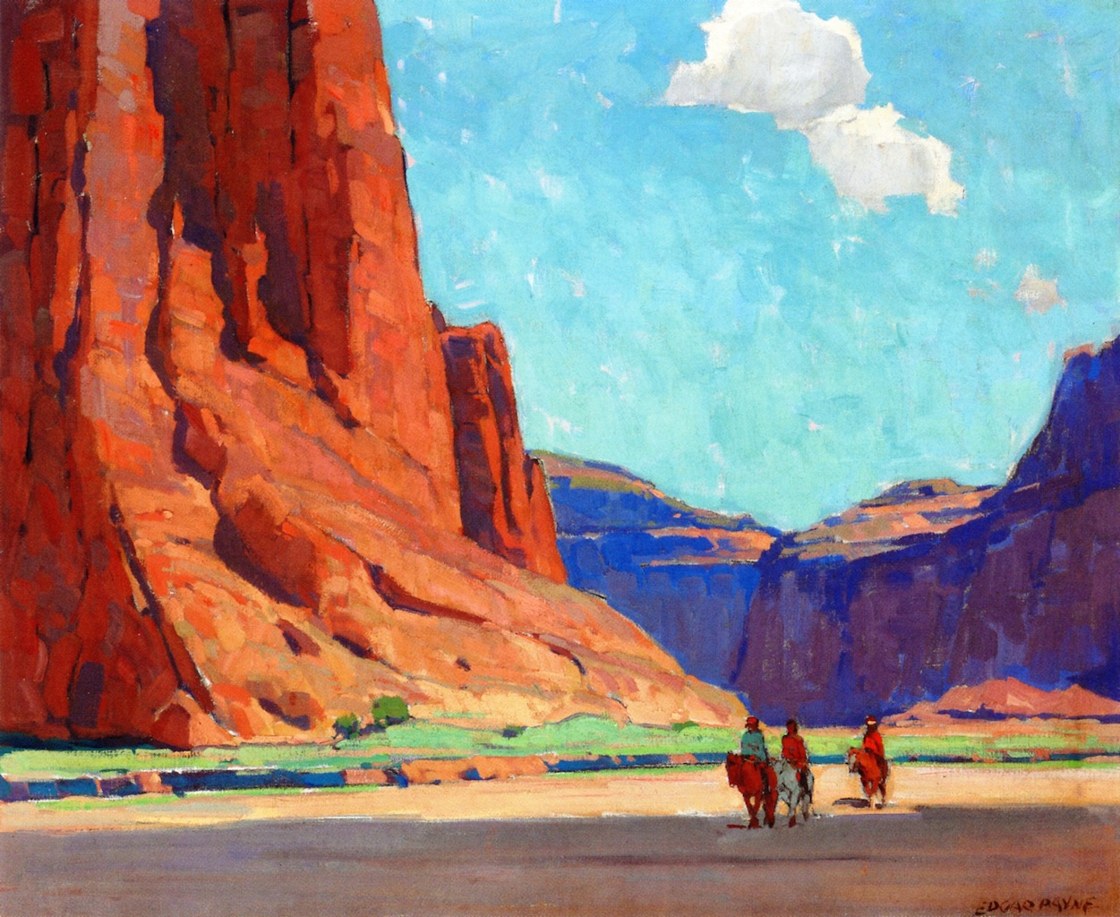 |
| Edgar Payne, Riders in Canyon de Chelly, before 1947. Wikimedia Commons, public domain. |
| In the Canyon de Chelly riders you can see a steelyard almost literally: the huge sunlit cliff fills one side of the picture, and the tiny group of riders, set far to the right on the light ground, is enough to balance it. The cliff gives the scale; the riders give the meaning. They pick up the warm-and-cool contrast seen in the rest of the picture and, through their small shapes, they add a contrast of size and shape. On top of that, there is the human appeal that draws the eye. |
| For us, on the banks of the Guiers Mort, the lesson is direct. Before getting the colours out, ask: what is my big mass, where is my counterweight, and by which path does the eye enter the picture? A small value sketch is often enough to answer, and it saves discovering, three hours later, that the painting has no frame to hang on. |
| You can try several of these schemes on your own paintings with the Structure tool in the Composition app, described below. |
| Atelier Joseph Sherriff |
From the letter of 5 November 2026
Lire en français