| Pencil pictures built from a few shapes of light and dark |
| As a boy, leafing through a book that belonged to my father, I was struck by Ted Kautzky's trees: dark silhouettes against light, light branches against dark, the two weighed against each other like a balance. My father had a word for it: counterpoise. It is still what I look for when I plan a painting. |
| Theodore "Ted" Kautzky was born in Budapest in 1896 and trained as an architect. In 1923 he left for New York, where he worked as an architectural designer and renderer. His name spread through drawing. In 1935 the magazine Pencil Points ran a pencil-sketch competition, and Kautzky took first prize. With the magazine's editor, Reid, he went on to publish Pencil Broadsides (1940), "a manual of broad stroke technique", and Pencil Pictures (1947), later followed by books on watercolour, including Ways with Watercolor (1949). He taught at Pratt Institute, New York University and the University of Pennsylvania, and died in 1953, aged 56. |
| He is remembered above all for his pencil work, his "pencil paintings", as he called them. The name fits. Using the broad side of the lead, he laid down whole planes in one stroke: a roof as a single dark band, a wall left as bare paper, a mass of foliage as one mid-tone. There are only a few values, and each has a job. The light side of a house reads because the shadow beside it is decisive. Nothing is shaded "to be safe". |
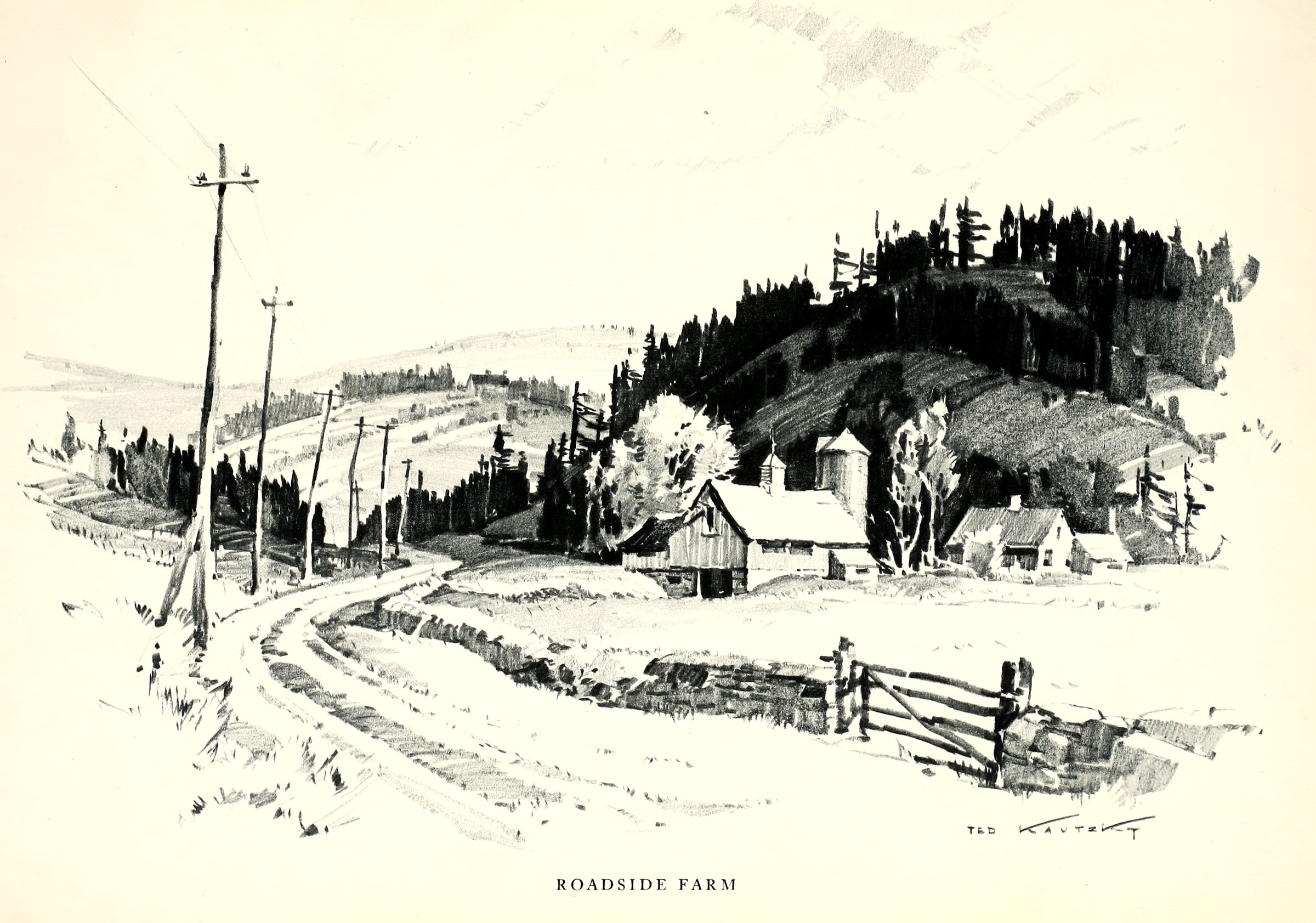 |
| Ted Kautzky, Roadside Farm, 1947. Broad-stroke pencil. From Pencil Pictures: A Guide to Their Pleasing Arrangement (Reinhold, 1947); scan via Internet Archive, public domain in the EU. |
| In Roadside Farm the whole picture is built from a handful of shapes: the dark wooded hill, the pale roofs of the farm set against it, and the white road curving in from the foreground. The darks are grouped in one mass behind the buildings, the sky and road are left almost empty, and that contrast pulls the eye straight to the farm. |
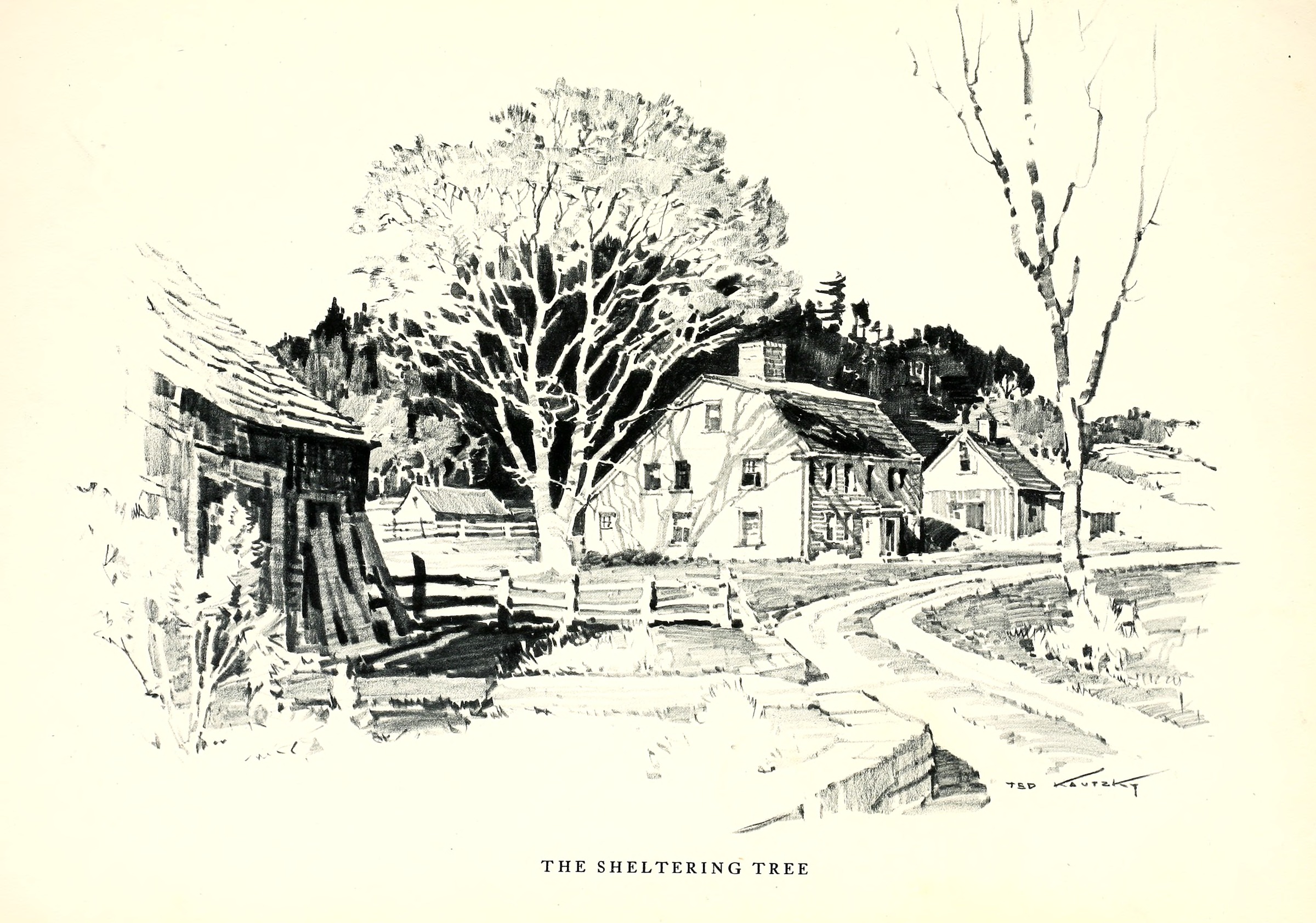 |
| Ted Kautzky, The Sheltering Tree, 1947. Broad-stroke pencil. From Pencil Pictures: A Guide to Their Pleasing Arrangement (Reinhold, 1947); scan via Internet Archive, public domain in the EU. |
| The Sheltering Tree shows the counterpoise I remember. The big tree in the middle is drawn almost entirely as light: pale trunk and branches cut out against a band of dark woods behind the house. On the right, a thin bare tree does the opposite, its darker trunk standing against an empty sky. The same subject, a tree, is light on dark in one place and dark on light in the other, and the house sits between them. |
| Why does this matter for us at the easel? Because the hardest step in landscape painting is not the brushwork but the decision about what to leave out. Kautzky's drawings show, page after page, how a scene becomes a few shapes of light and dark arranged on a rectangle. Beside a Chartreuse stream, with rocks, foam, branches and reflections all asking for attention, that is the question to ask first: what are my three or four big shapes, where are my darks, and what will stand light against them? |
| Atelier Joseph Sherriff |
From the letter of 29 October 2026
Lire en français