| John Singer Sargent (1856–1925) was an American painter, born in Florence to expatriate parents. In 1874 he entered the Paris atelier of the portraitist Carolus-Duran. Portraits made his reputation on both sides of the Atlantic. Around 1907–1908 he said he was "shutting up shop in the portrait line", and he turned more of his time to landscapes, informal figure studies and murals. He died in London. |
| What interests me in Sargent's work is the precision that underlies a seemingly loose gesture. We can see it plainly in his figure work and, most relevant for me, in his treatment of water. Precision and looseness recur together throughout his work, and together they give a sense of vitality and freshness that has lasted more than a century. |
| This looseness can only work convincingly when the structure underneath is exact. It relies on precise observation, disciplined drawing, and capturing something essential in the expression: the tilt of a figure's head, the shape of a shadow around a rock, or the underlying value structure of a composition. |
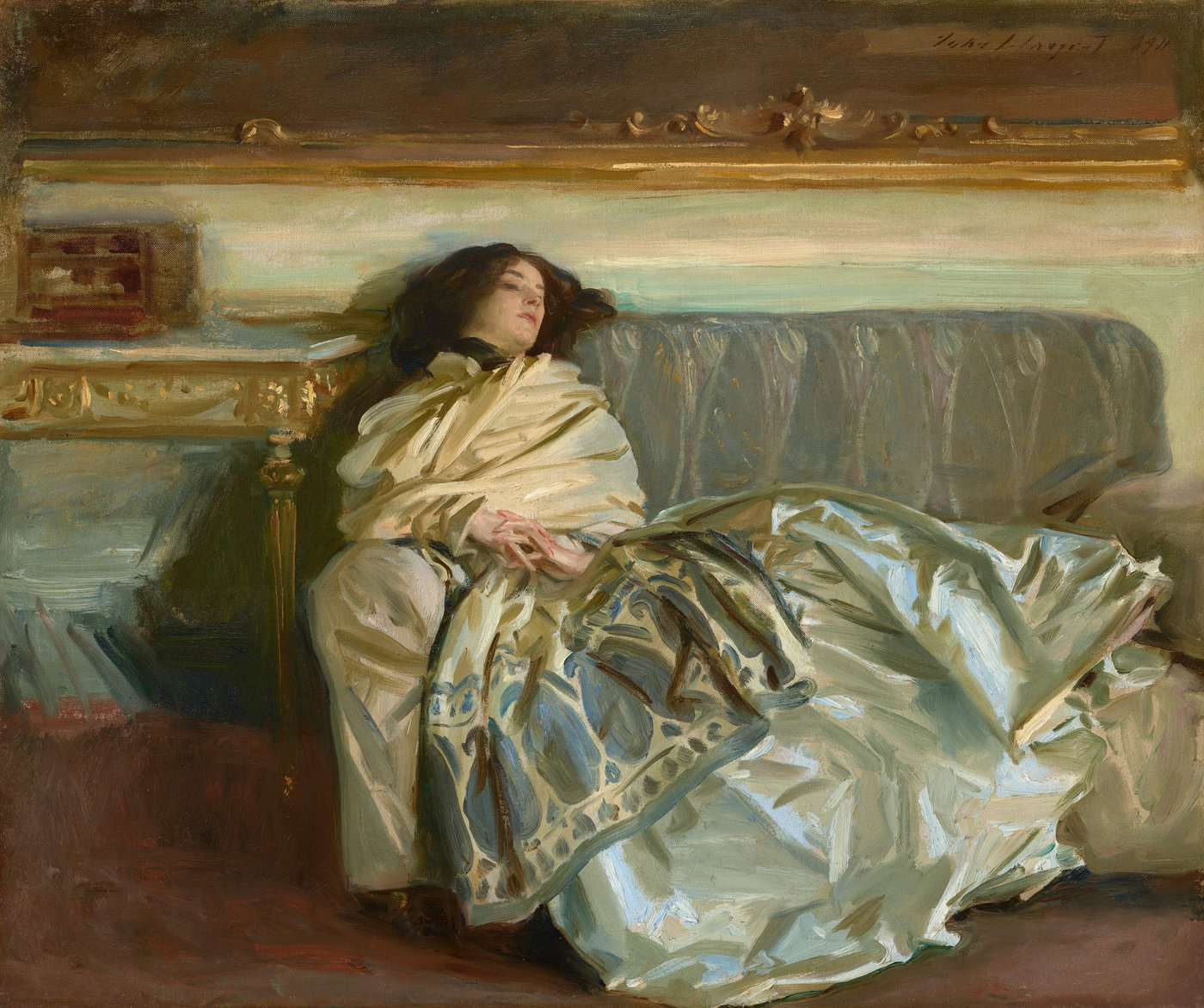 |
| John Singer Sargent, Nonchaloir (Repose), 1911. Oil on canvas, 63.8 × 76.2 cm. National Gallery of Art, Washington. Gift of Curt H. Reisinger (public domain). |
| The woman is Sargent's niece, Rose-Marie Ormond, though this is not a formal portrait. He first called the picture Nonchaloir. If you zoom in, you will see very loose but extremely precisely placed gestures that suggest the folds of the cloth with great plasticity; you can feel its silkiness. The features suggest the volume of the face and the skull, and we must imagine with reasonable likeness. The gilded frame is suggested with a few accurate strokes that capture the movement and the glow of the gilding, with great economy of means. The accuracy of the face and hands matters too, because that is where our attention goes first. And, of course, the whole scene captures the mood of the resting figure. |
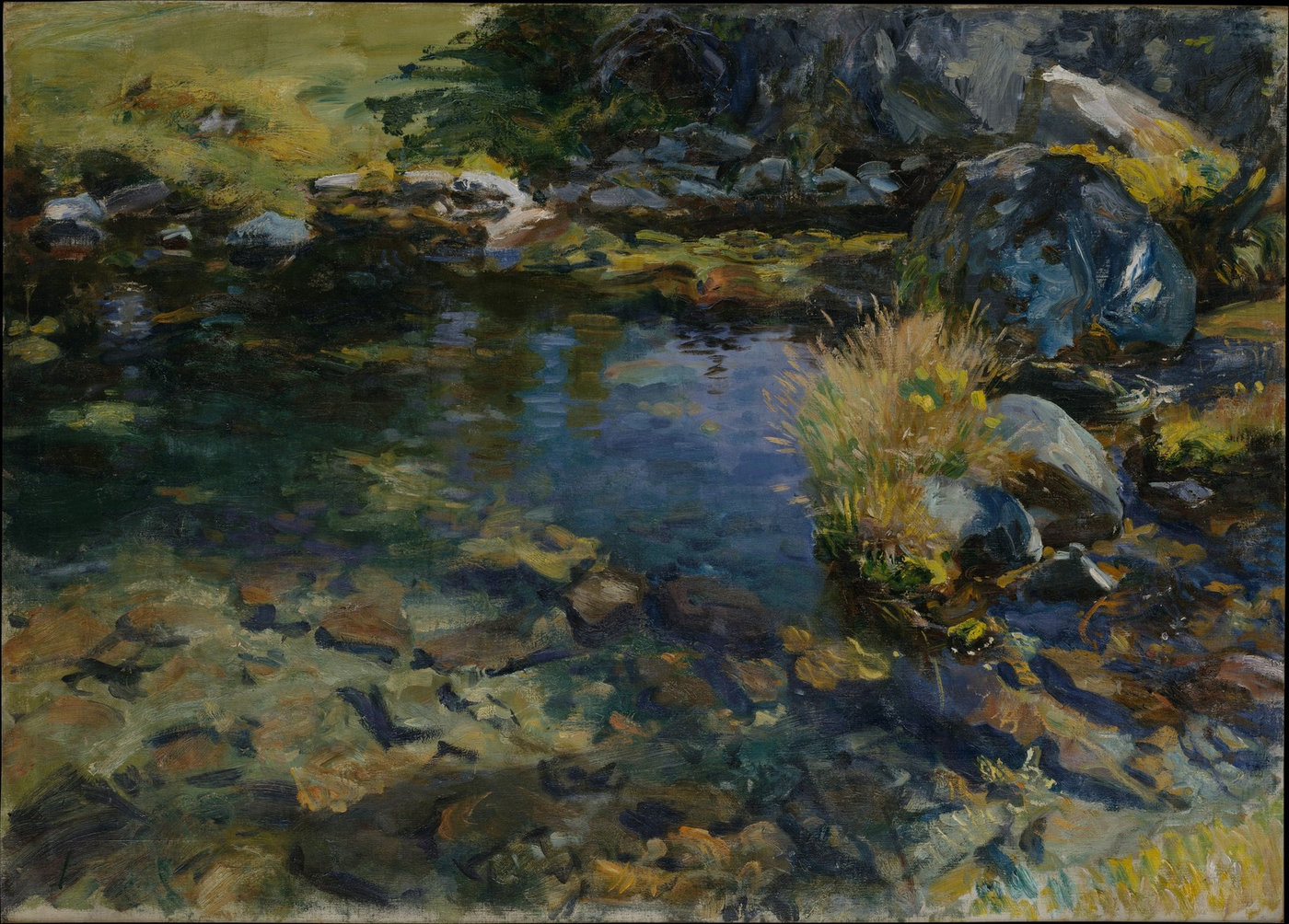 |
| John Singer Sargent, Alpine Pool, 1907. Oil on canvas, 69.9 × 96.5 cm. The Metropolitan Museum of Art, New York. Gift of Mrs. Francis Ormond, 1950 (public domain). |
| He brought the same approach outdoors. In 1907, staying at Purtud, north of Courmayeur in the Italian Alps, he painted a series in oil and watercolour of the hamlet's small mountain brook. Alpine Pool is a close view, looking down. |
| As somebody who spends a lot of time painting water, this painting has caught my attention on a number of occasions. When you paint water, there are several layers to consider. You start at the bottom: the sand and the rocks. You don't see them directly; they are distorted by the refraction of the water. |
| The movement of the water adds another layer of distortion. Then there is the surface itself, which shows up around rocks that stick out of the water, as at the top right. Notice the freshness of that rock and of the reeds growing there, compared with the more muted colours under the water. |
| Reflections bounce off the surface and can also suggest movement, and the colours reflected on the surface mix with the objects beneath. The interplay of colours can become very complex. |
| What we see here is a masterful rendering, again with great economy of means, of a simple rock pool: a contrast between what is below the water and what is above, and between what is in light and what is in shade. |
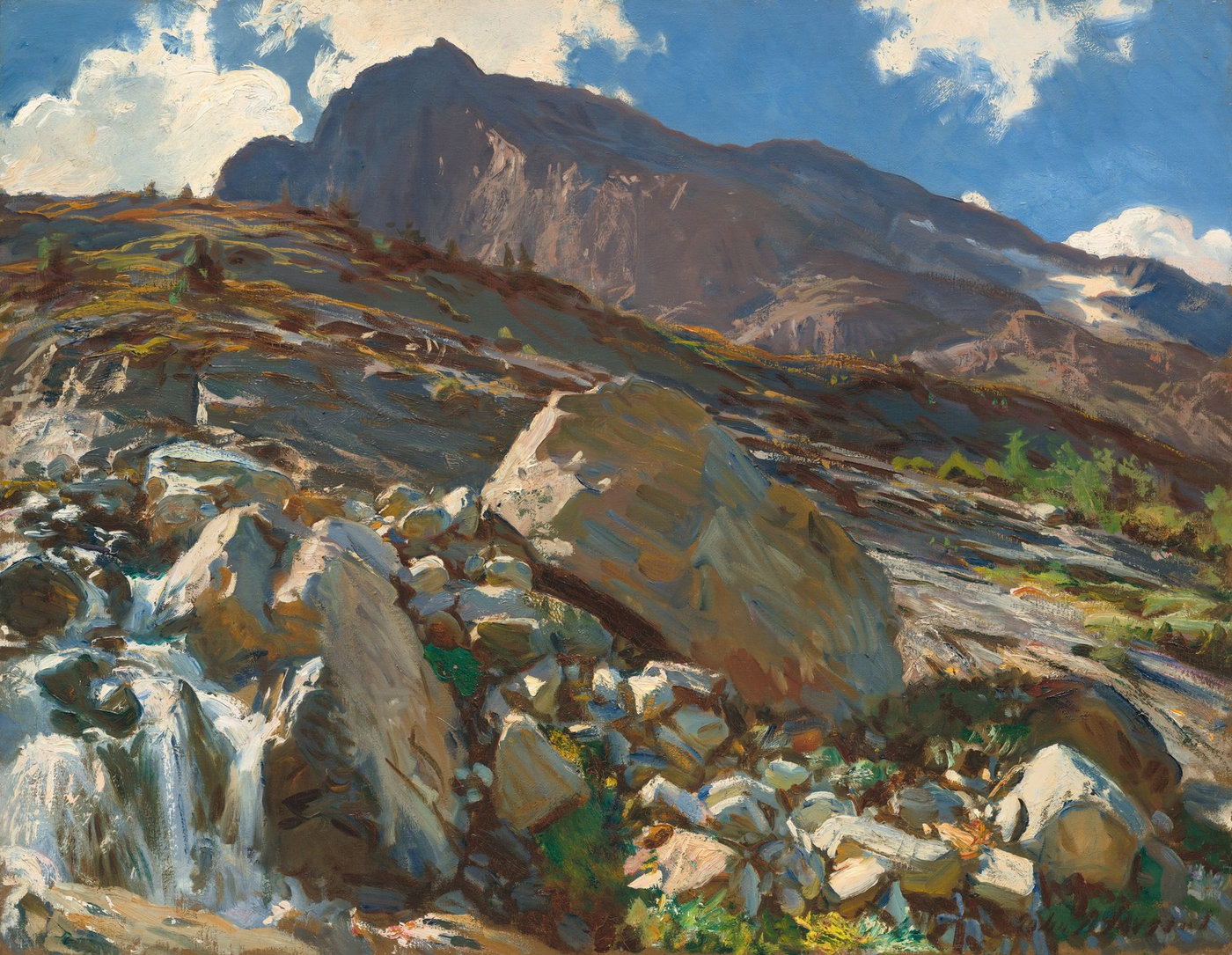 |
| John Singer Sargent, Simplon Pass, 1911. Oil on canvas, 71.8 × 92.6 cm. National Gallery of Art, Washington. Corcoran Collection (Bequest of James Parmelee, 1941) (public domain). |
| Simplon Pass, painted in 1911, opens the view. Sargent had known this Alpine pass, on the Swiss–Italian border, since at least 1904, and he returned for long stays in 1909, 1910 and 1911. |
| One of the first things I notice in this painting is that it is more about shapes. Another painter, myself included, might have made the water the main subject; here it serves only as a bracket in the lower-left corner, a textural complement to the small rocks in the middle foreground. The larger shapes dominate: the central boulder, the rocky slope behind it, and the distant mountain surrounded by sky and clouds. The colour is very interesting too, above all the contrast of warm and cool: warm light, and cool blue shadows lit by the sky. Colours are more muted in the distance and strong and saturated in the foreground, with some surprising colours in the shadows. We still find similar treatment today in the work of many landscape painters, such as Kimball Geisler, Mark Boedges, Kathleen Hudson and, I'm sure, many others. |
| Atelier Joseph Sherriff |
From the letter of 13 November 2026
Lire en français