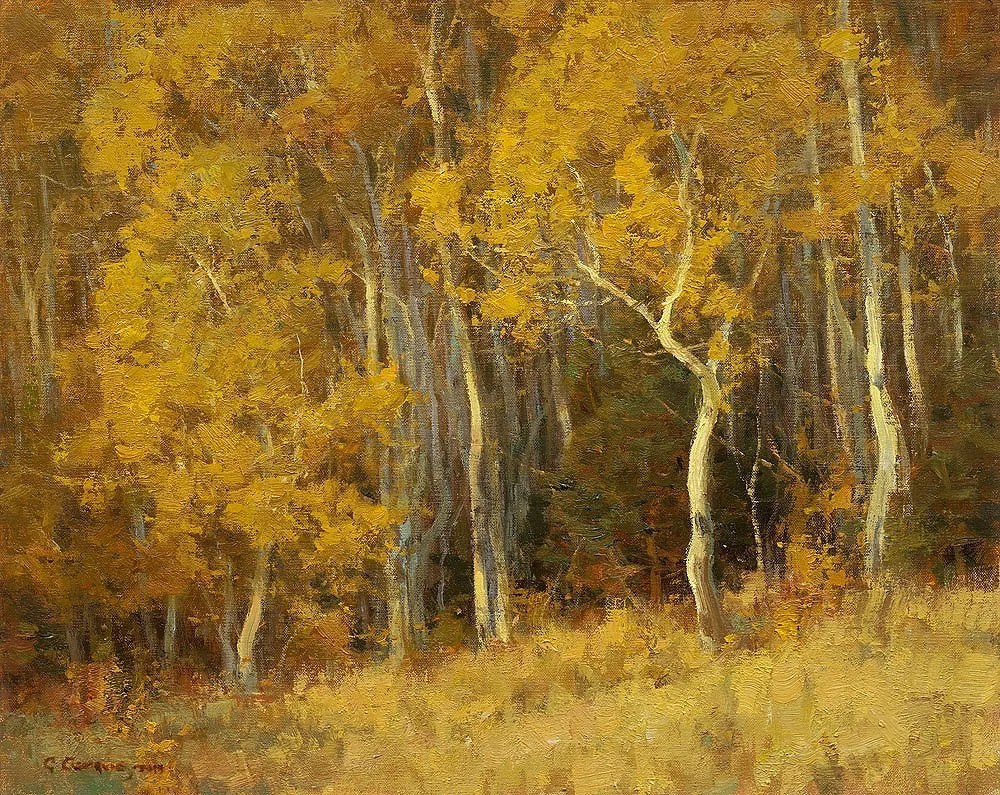
Clyde Aspevig is an American landscape painter, widely regarded as one of the finest contemporary landscape painters, both on location and in the studio. He grew up on a farm near Rudyard, Montana, not far from the Canadian border; his father, a practical but open-minded farmer, bought his first painting when Clyde was twelve. He studied at Eastern Montana College in Billings and now lives near Bozeman with his wife, the painter Carol Guzman.
His field easel has taken him from the mountains and prairies of Montana to Death Valley, the Adirondacks, the rocky North Atlantic coast, the Scandinavian fjords and the hillsides of Tuscany. His paintings are in many museum collections — the Tacoma Art Museum, Denver Art Museum, Gilcrease Museum and Rockwell Museum among them — and his awards include the Prix de West Award (1997) and the California Art Club’s Edgar Payne Award (2013).
What a plein air painter can learn from him:
Look without clichés. “Because I grew up in a vacuum in Montana, I wasn’t taught the cliches,” he says. He resisted dealers who wanted to restrict him to saleable panoramic scenery. In front of the motif, the question is not “what makes a good picture?” but “what am I actually seeing?”
Leave things out. In his view, some of his most powerful pictures are those that leave something out. The sense of space, rhythm and harmony in his canvases is no accident.
Paint the way you’d compose music. “I use music all the time in my paintings.” Think of brushwork in rhythms — broad and slow, quick, accented — rather than in details.
Technique serves the idea. He wants technique never to override a painting’s essential concept. A field study doesn’t need to be virtuosic; it needs to say something.
Among the books he lists as inspiration: Carlson’s Guide to Landscape Painting, a classic for any landscape painter.
Paintings: clydeaspevig.com/collections
Official site: clydeaspevig.com